Which part of Harlem is the listing in?
The boundaries are loose. StreetEasy, a listings site, splits the area into Central Harlem, East Harlem and Hamilton Heights, which sits next to St. Nicholas Park. Other sites and brokers draw the lines differently, so look at the actual address and the nearest train, not the neighborhood name.
How much is rent?
These are StreetEasy's median asking rents for October 2026. Asking rent is what landlords list, not what tenants end up paying.
| Area | 1-bedroom | 2-bedroom |
|---|---|---|
| Central Harlem | $3,050 | $3,800 |
| East Harlem | $3,100 | $3,300 |
| Hamilton Heights | $2,695 | $3,300 |
| Manhattan overall | $4,936 | $6,395 |
In each part of Harlem, the median two-bedroom lists for less than the median one-bedroom in Manhattan as a whole.
Which trains run through Harlem?
Ten subway lines, and every one of them stops at a 125th Street station.
- A, B, C and D on St. Nicholas Avenue and Frederick Douglass Boulevard. The A and D run express. From 125th Street their next stop is 59 St-Columbus Circle. The B runs weekdays until 11 p.m.
- 2 and 3 on Lenox Avenue, stopping at 110th, 116th, 125th and 135th Streets. They run express south of 96th Street.
- 4, 5 and 6 on Lexington Avenue. The 4 and 5 stop only at 125th Street in Harlem. The 6 also stops at 116th, 110th and 103rd.
- 1 on Broadway, a local, at 116th, 125th, 137th and 145th Streets.
The M60 Select Bus to LaGuardia Airport stops near several of these stations. Metro-North trains also stop at 125th Street near Lexington Avenue.
The MTA is building a Q line extension with new stations at 106th Street, 116th Street and 125th Street and Lexington Avenue. It is still under construction and the project page gives no opening date, so don't choose an apartment because of it.
What are the buildings like?
Central Harlem is mostly apartment buildings, split about evenly between walk-ups and elevator buildings, according to the city's planning department. Row houses are a smaller share.
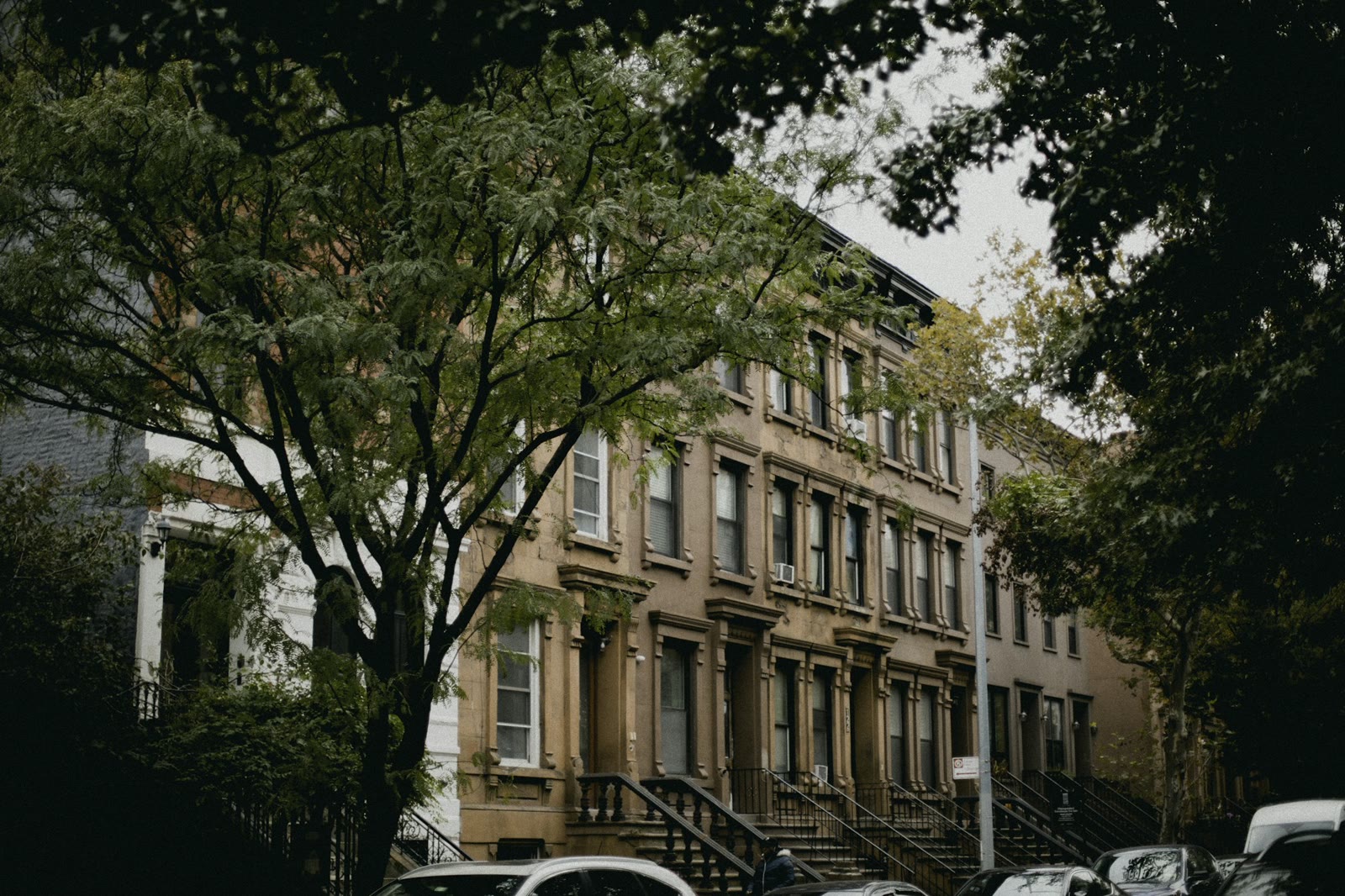
Many of the row houses, often called brownstones, were built for one family and later divided into apartments. That matters for your rent.
- A row house with a few apartments is usually not rent stabilized. Stabilized apartments are most often in buildings with six or more units built before 1974.
- A larger prewar building may be stabilized, which limits how much the rent can go up each year. Here is how to check.
- A walk-up has no elevator. Ask which floor the apartment is on before you go.
Where are the parks?
- Central Park's northern edge is 110th Street.
- Morningside Park runs from 110th to 123rd Street along a steep hill, with playgrounds, ball fields and a Saturday farmers market.
- Marcus Garvey Park, Madison Avenue from 120th to 124th Street, has an outdoor pool, an indoor pool and an amphitheater.
- St. Nicholas Park covers about 23 acres from 128th to 141st Street.
- Thomas Jefferson Park, between First Avenue and the FDR Drive from 111th to 114th Street, has an outdoor pool and a running track.
Is it safe? Will I like it?
We don't rate neighborhoods on that. Judge the block yourself.
- Visit on a weekday evening and on a weekend, not just at the showing.
- Walk from the train you'd actually use to the front door, and time it.
- Stand outside for ten minutes. Listen for street noise.
- Ask someone who lives on the block what they like and what they'd change.
What should I text the broker?
Hi, I'm interested in [address, apartment]. How many apartments are in the building, and is this unit rent stabilized? What floor is it on, and is there an elevator? Thanks.
This is general information. Rents and train service change, so check the sources below before you plan around a number.
Sources
- StreetEasy Data Dashboard, median asking rent: October 2026 median asking rents for one- and two-bedrooms in Central Harlem, East Harlem, Hamilton Heights and Manhattan, and the neighborhood names StreetEasy uses
- MTA, A line map: A stops at 145 St and 125 St, then 59 St-Columbus Circle
- MTA, D line map: D stops at 145 St and 125 St, then 59 St-Columbus Circle; M60 SBS to LaGuardia at 125 St
- MTA, C line map: C and B stations at 110, 116, 125, 135 and 145 St; B weekdays until 11 p.m.
- MTA, 2 line map: 2 and 3 local stations on Lenox Avenue, express stops at 96 St and 72 St, M60 SBS at 125 St
- MTA, 4 line map: 125 St is the only Harlem stop for the 4 and 5
- MTA, 6 line map: 6 stations at 125, 116, 110 and 103 St
- MTA, 1 line map: 1 local stations at 116, 125, 137 and 145 St
- MTA, Second Avenue Subway Phase 2: planned Q stations at 106 St, 116 St and 125 St-Lexington Av, construction status, connection to Metro-North at 125 St
- NYC Department of City Planning, Manhattan Community District 10 profile: Central Harlem land use by share, including walk-up, elevator and one- and two-family buildings
- NYC Landmarks Preservation Commission, Mount Morris Park Historic District Extension (2015): Harlem row houses built mainly as single-family homes and later converted into smaller apartments
- NYC.gov, Rent Stabilization: stabilized apartments are most often in buildings with six or more units built before 1974
- NYC Parks, Central Park: park runs from 59th to 110th Street
- NYC Parks, Morningside Park: 110th to 123rd Street, hillside, playgrounds, ball fields, Saturday market
- NYC Parks, Marcus Garvey Park: location, outdoor and indoor pools, amphitheater
- NYC Parks, St. Nicholas Park: 128th to 141st Street, 22.74 acres, borders Hamilton Heights
- NYC Parks, Thomas Jefferson Park: location, outdoor pool, running track